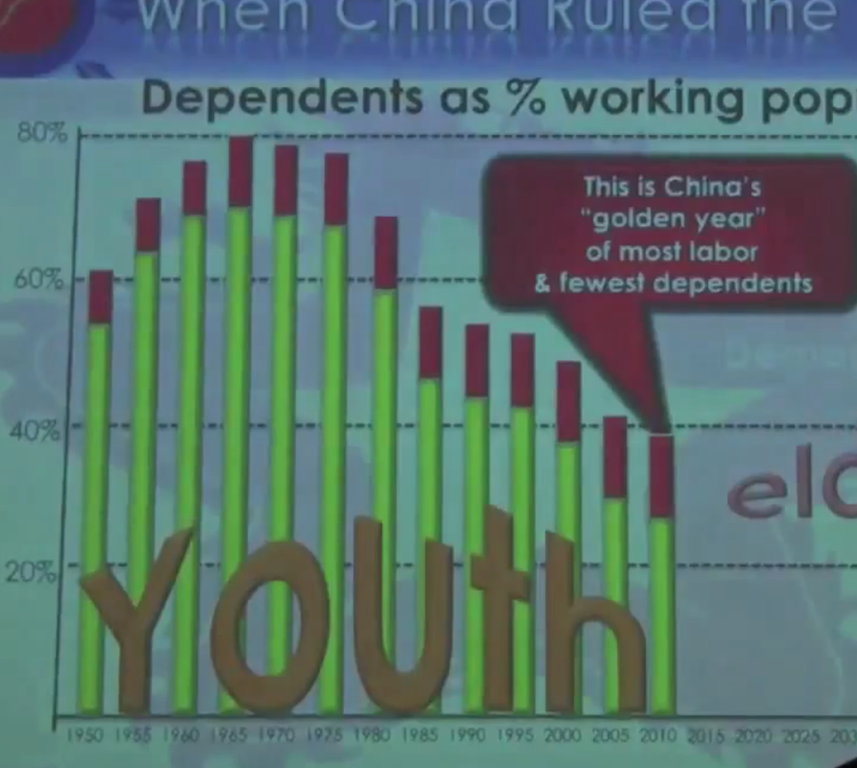
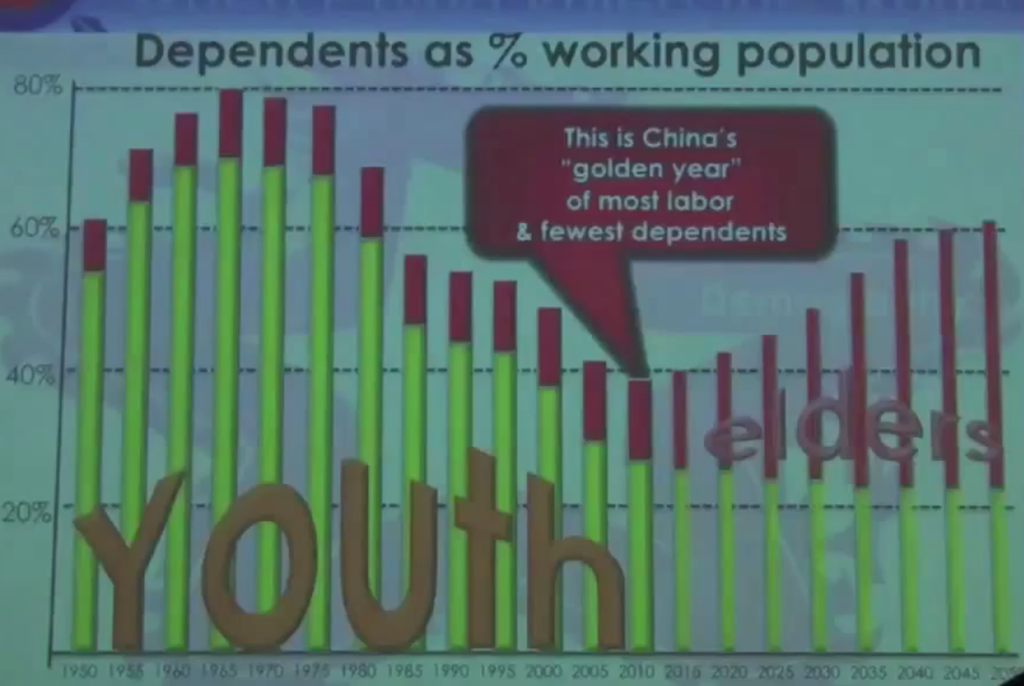
In 1965, about 80% of China’s population would be considered dependent. The vast majority of this is children. China introduces the one child policy that reduces the number of children over the next few decades. This frees up more people to work, frees up more resources, and allows for China to compete with the rest of the world on low labor costs. In 2010, the decreasing “dependent†population changed direction. That was the lowest year of the dependent population, and from here out China will see an increasing dependent population.
However, the growth in this group comes from “eldersâ€. People who are retired. People who no longer and will be unlikely to participate in the labor force again. Here is the projection from WikiStrat.
The “elder†population will slow China’s growth. They will consume more resources than the previous dependents population that was made of children. And unlike children which could be expected to start contributing to the labor pool as early as 10 years old. The elder population are not expected to enter this pool.
The elder population while not likely to contribute to the labor pool, their experience and knowledge could drive the transition from a labor based economy to a wisdom based economy.
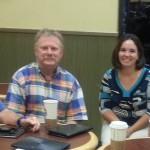
Each Tuesday morning a few of us in the Home Happiness Industry get together to swap stories, share ideas, and figure out how to help people have a happy home experience.
But sometimes the stories of home unhappiness are more interesting to share. Â Blake the inspector talked about issues he has had with his home builder. Â He also talked about home inspections in unsafe neighborhoods where agents suggested his CHL would come in useful.
This lead into a discussion about visiting vacant homes only to find squatters in them.  And even one story of a home under construction where a dead body was found.  A murder on a property is something that has to be disclosed (if known).  And it can negatively affect home value.  Not so many people are OK with the thought of a death taking place where they live.  The house in question was in the framing stage.  The builder figuring they would loose more by finishing construction and having to report the murder, decided it was better to tear down the house and start over.
This lead to another discussion about a foundation being backwards and it was discovered in the framing stage. Â builder got a crane, picked up the framed house, moved it to an adjacent lot. Â Re-poured the foundation. and then put the framing back on it.
Jim also bought an interesting relationship tidbit. Â Apparently in relationships where chores are split 50/50, there is a higher divorce rate. Â This lead into all sorts of discussions about why that might be, and a discussion on how the method of doing chores varied between each of us and our spouse.
We had a really good time, and it was worth while!
Numbers are powerful things. Â They allow for you to compare things easily, and talk about how something is a specific amount more than something else. Â We use them all over the place. Â To keep track of how much we earn and spend. Â To keep track of the days, hours, minutes, and seconds of our lives. Â We measure how much people know or have learned using GPAs and test scores. Â We can even talk about how strong or fast one person is compared to another using them.
I was over at a friends house a few weeks ago. Â He told me that he stopped counting. Â Stopped counting! Â What does it mean? Â And why would you do it? Â He says that he has tried to stop using numbers in his daily life as much as possible. Â Just live life. Â He might be on to something.
Every experience a person might have has been packaged up, quantitatized, and monatized.  Rather it be from having a pleasant meal, to entertainment, even to have someone take that personal touch and listen to you.  All of it can be bought, sold, and traded like so many thing a bobs.
And it become infectious. Â Now instead of just enjoying the vegetables from our gardens we start to think about how much these would have cost at the grocery store. Â Instead of enjoying that meal made by our loved ones, we calculate how much better and cheaper it was than getting it from a restaurant.
Even a blog like this. Â Perhaps it would be best to have only one person read this that I could connect with. Â Instead of having hundreds of strangers that I will never interact with on any meaningful way.
Numbers are a powerful tool. Â Like any tool, they should be use with great care.
Entrez WWW Server. A search and retrieval system that integrates information from databases at NCBI.
Entrez Nucleotides Database. A collection of sequences from several sources, including GenBank, RefSeq, and PDB.
Entrez Protein Database. A database compiled from a variety of sources, including SwissProt, PIR, PRF, PDB, and translations from annotated coding regions in GenBank and RefSeq.
GOBASE – The Organelle Genome Database. A taxonomically broad organelle genome database that organizes and integrates diverse data related to organelles.
Ribosomal Database Project II. Online data analysis of ribosomal sequences, rRNA derived phylogenetic trees, and aligned and annotated rRNA sequences. Michigan State University.
ExPASy Molecular Biology Server. Expert Protein Analysis System proteomics server of the Swiss Institute of Bioinformatics (SIB), dedicated to the analysis of protein sequences and structures as well as 2-D PAGE.
ISIS: Intron Sequence and Information database. A comprehensive web based intron information system containing all identifiable spliceosomal intron sequences in GenBank with information about both individual sequences and gross properties of natural groupings of sequence (for example by taxa ) using a nonredundant subset of the data.
Reciprocal Net. A distributed database used by research crystallographers to store information about molecular structures.
National Biological Information Infrastructure (NBII). An electronic gateway to biological data and information maintained by federal, state, and local government agencies, private sector organizations, and other partners around the nation and the world.
TimeTree. A database of species divergence times. Penn State and Arizona State University.
WildFinder. Mapping the World’s Species. A map-driven, searchable database of more than 30,000 bird, mammal, reptile, and amphibian species worldwide. World Wildlife Fund.
uBio – Universal Biological Indexer and Organizer. A system of client and server tools that interact with the Taxonomic Name Server (TNS), which serves authoritative taxonomic opinions within a multi-classification framework. The Marine Biological Laboratory, Woods Hole.
OBIS. Ocean Biogeographic Information System. A globally-distributed network of systematic, ecological, and environmental information systems to communicate biological information about the ocean.
Man and the Biosphere Species Databases. Databases of vascular plant and vertebrate animal occurrences on the world’s biosphere reserves and other protected areas.
Species in Parks: Flora and Fauna Databases. Databases of vascular plant and vertebrate animal species reported to occur within lands managed by the U.S. National Park Service.
Biota of North America Program (BONAP). Data for all vascular plants and vertebrate species (native, naturalized, and adventive) of North America, north of Mexico.
MaPSTeDI. A collaborative effort between the University of Colorado Museum, Denver Museum of Nature and Science, and Denver Botanic Gardens to convert separate collections into one distributed biodiversity database and research toolkit for the southern and central Rockies and adjacent plains.
German Collection of Microorganisms and Cell Cultures (DSMZ). An independent, non-profit organization dedicated to the acquisition, characterization and identification, preservation and distribution of Bacteria, Archaea, fungi, plasmids, phages, human and animal cell lines, plant cell cultures and plant viruses.
The Fossil Record 2. A near-complete listing of the diversity of life through time, compiled at the level of the family. University of Bristol.
The Paleobiology Database. Providing global, collection-based occurrence and taxonomic data for marine and terrestrial animals and plants of any geological age.
PaleoBank. A relational database for invertebrate paleontology.
NMITA: Neogene Marine Biota of Tropical America . An online biotic database containing images and data for taxa used in analyses of Tropical American biodiversity over the past 25 million years.
PaleoBase. An illustrated, relational database of invertebrate fossils for education and research. The Natural History Museum, London.
Brain Biodiversity Bank. National Museum of Health and Medicine, Michigan State University, University of Wisconsin.
At least that is memory aide that I learned in high school to remember the different layers of biological taxonomy.
Kingdom
Phylum
Class
Order
Family
Genus
Species
Each species is grouped into genus by a common traits. Â The genus are group into family. Â Family into Order. Â Order into Class. Â Class into Phylum. Â And finally Phylum into Kingdom. Â There are different number of kingdoms depending on who you talk to, how they define life, and when they learned taxonomy. Â Let’s look at six of them.
Archaebacteria, Eubacteria, Protista, Fungi, Plantae, Animalia
We humans are under the Animalia Kingdom. Â Here is how it maps out for us:
Domain Eukarya
Kingdom Animalia
Phylum Chordata
Subphylum Vertebrata
Class Mammalia
Order Primates
Family Hominidae
Genus Homo
Species sapiens
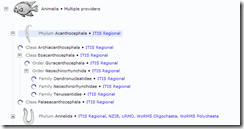
What I am looking for is a website that will let me click on Animalia, and see the different Phylums.
I found a highly scientific tool at the NCBI called Taxonomy Browser. Â But it only includes single celled lifeforms. Â And it is targeted at the specialist.
Have you heard about Mars One? Â Here is what they say they are:
Mars One is a private, apolitical organization whose intent is to establish a colony on Mars through the integration of existing, readily available technologies from industry leaders world-wide. Unique in its approach, Mars One intends to fund this decade-long endeavor through an interactive, reality TV style broadcast from astronaut selection to robotic construction of the outpost; from the seven month flight through the first years on Mars.
Now, I love the idea of going to Mars. Â I am OK even with having one way trips to do so. Â (Got to die somewhere, right?) Â I really love the video they put together:
And I would love to believe that they would be able to pull it off. Â But they do not have the funds or the staff to pull it off. Â They do not have the billions that would be required or the expertise.
Here is the timeline that they currently plan:
2013:
This will be the year in which our astronaut selection begins! Who will be the first four humans on Mars and who are to follow every two years after? Anyone who meets the criteria and feels they are up to the challenge can apply. Mars One will maintain 40 trained astronauts during the full duration of its missions.
By the close of 2013, Mars One will build a replica of the Mars settlement on Earth, likely in a cold, desolate environment, to help the astronauts prepare and train and for a realistic environment in which to test the equipment. The astronaut selection and the preparations in the simulated Mars base will be broadcast world-wide for the public to view.
2016:
The supply mission will be launched for Mars in January 2016. It will land on the Red Planet in October 2016 with its cargo of 2500 kilograms of spare parts, solar photovoltaic panels, and general supplies. It will land close to where the outpost is expected to be.
What will most definitely happen is that in 2013 a call will be put out for volunteers wanting to go to Mars.  There really will be training and a mock up built here on earth.  It really will be a media spectacle.  There will be sponsors for the show.  And it will make considerable amount of money.  Probably in the $100 of millions.
What will not happen is actually sending anything into space. Â The entire event will be done here on the grown, with no hope of anything be launched into orbit. Â There will especially not be anything or anyone going to Mars because of this.
Why? Â Well you see, the ground stuff is safe and cheap. Â It also makes for better TV. Â But anything that is actually sending things to space is costly, risky, and does not make for good TV. Â It won’t happen being funded this way, with this group of people.
I wish it were otherwise. Â And I hope I am wrong. Â But I do not see how I could be…
Processing is a computer language.  It can be downloaded at http://www.processing.org/.  It’s creators confess:
Processing seeks to ruin the careers of talented designers by tempting them away from their usual tools and into the world of programming and computation. Similarly, the project is designed to turn engineers and computer scientists to less gainful employment as artists and designers.
It is uses a similar IDE as Arduino. Â And many people use Processing and Arduino together. Â Processing runs on the computer and can interact with the arduino over the serial port allowing for you to create a bridge between the desktop/online world and your handcrafted/custom electronic devices.
What can you do with Processing?
Ok, interested enough to get this far? Â Take a look at these examples: